Traditional UV adhesive vs. 5G Low Dk solder joint protection adhesive: What are the differences in high-frequency signal?
The Hidden Key to Improving High-Frequency Signal "Impedance Distortion" and "Solder Joint Fracture":
Low Dk Solder Protection Adhesive Solution!!
As connectors enter the 5G/6G era, the dispensing process has become a key factor affecting product performance~
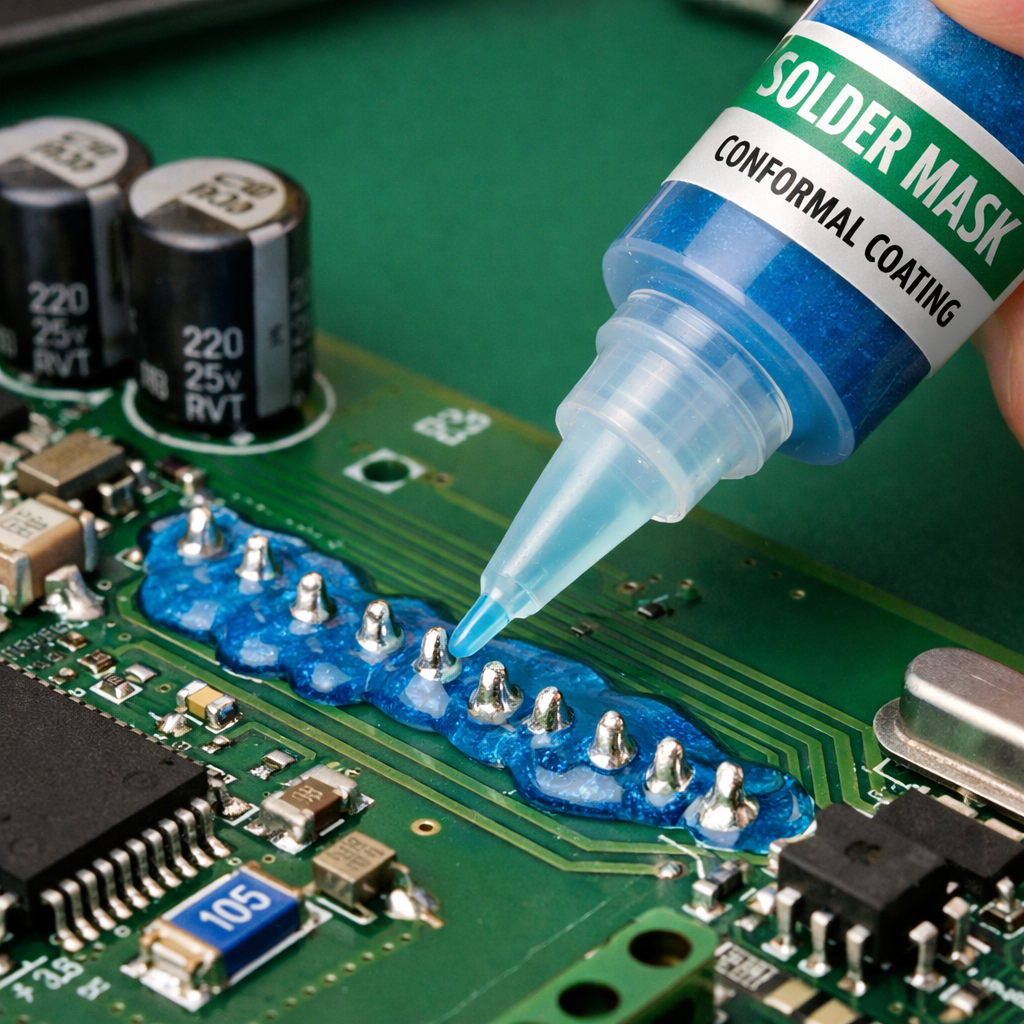
Under 5G millimeter wave and high-speed computing architectures, manufacturers of high-frequency connectors and cable assemblies face issues such as "sudden impedance drop" or "excessive high-frequency loss." In reliability testing, adhesive materials that cannot buffer stress may lead to solder joint cracking and failure.
For high-frequency applications such as High-Speed I/O, Board-to-Board, and Wire-to-Board, traditional UV adhesives will significantly weaken product advantages.
We provide solder joint protection solutions designed for both "signal integrity" and "mechanical strength."
1. Protecting Signal Integrity: Impedance Matching Advantage Brought by Extremely Low Dk
High-frequency signals are highly sensitive to dielectric materials. The dielectric constant (Dk) of general UV adhesives is usually relatively high (>3.0). After dispensing coverage, it is easy to cause a decrease in characteristic impedance, leading to signal reflection.
- Our solution: providing special-grade protective adhesives with Low Dk (< 2.4) and Low Df (< 0.02).
- Benefit: making the adhesive nearly “invisible” in electrical properties, minimizing interference with high-frequency signals, and ensuring one-time pass in SI testing during mass production.
2. Strengthening Solder Joint Protection: Stress Release Mechanism with High Elongation (High Tensile Strength)
Connector cables need to withstand bending and insertion/extraction stress during assembly and use. If the protective adhesive is too brittle (low elongation) or only emphasizes low CTE, it often leads to adhesive cracking under dynamic conditions, and may even cause solder joint breakage.
- Our solution: possessing high elongation (high tensile strength) and excellent toughness.
- Benefit: after curing, the adhesive acts like a tough “buffer layer,” effectively absorbing stress during cable bending, preventing stress transfer to fragile solder joints, and significantly improving yield in tensile testing.
If you are facing challenges such as unstable impedance after dispensing or insufficient solder joint reliability, we can work together on “adhesive material selection consulting” and “UV curing parameter optimization” to build your competitive advantage.
#SolderProtectionAdhesive #UVAdhesive #LowDk #LowDielectricConstant #ImpedanceMatching #HighFrequencyConnectors #LCPBonding #StressRelief #CableAssembly #5GProcess #ReliabilityTesting #ElectronicAdhesives
CONTACT US
Kelly Chemical Corporation
Electronics
TEL:(02)2762-1985 ext 11200
Online Message
Leave your contact information,
and we will get in touch with you soon.
Email Consultation
After receiving your email,
we will process it as soon as possible.send Email


