The Key to Low Viscosity and High Crosslink Density: Applications of Advanced Modifiers in Electronic Packaging
How Can We Strike a Practical Balance Between Low Viscosity and High Crosslink Density?
In the development of advanced electronic materials and semiconductor packaging, material engineers face a deceptively simple yet highly challenging issue almost every day.
What appears to be a minor adjustment in formulation or processing conditions often involves balancing multiple factors simultaneously, including thermal stability, adhesion, dielectric properties, and long-term reliability. Even the smallest change can ultimately affect overall package performance and product reliability.
How Can Good Processability be Maintained While Still Ensuring Structural Strength and Long-term Reliability After Curing?
If viscosity is too high, problems such as incomplete filling, trapped voids, and unstable coating behavior can occur.
If viscosity is too low, insufficient crosslinking, reduced mechanical strength, and poor thermal stability may result.
This trade-off is almost unavoidable in adhesive systems such as encapsulants, underfills, and die attach materials.
The challenge becomes even more pronounced in highly filled thermal conductive systems or fine-gap filling applications, where both flowability and final structural strength are closely scrutinized. Optimizing a formulation in only one direction often comes at the expense of another property.
Under these application requirements, multifunctional epoxy modifiers have begun to demonstrate their value.
Why Does a Trifunctional Epoxy Structure Matter?
One representative example is Trimethylolpropane Triglycidyl Ether (TMPTGE), a typical trifunctional epoxy monomer.
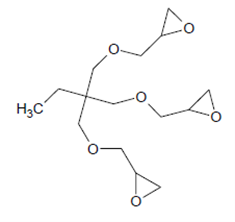
Structurally, TMPTGE contains three epoxy groups (oxirane rings) located at the ends of the molecular backbone. This design enables participation at three reactive sites during curing, allowing the formation of a highly crosslinked three-dimensional network.
These materials typically exhibit several characteristic features:
- Viscosity around 200–400 cP at 25°C
- Epoxy equivalent weight (EEW) of approximately 130–160 g/eq
- Liquid form with excellent flowability
- High reactivity
The key advantage of this type of material lies in an important characteristic: although it has low viscosity in liquid form, it still contributes to network formation after curing. In other words, it functions not merely as a reactive diluent, but as a material capable of simultaneously reducing viscosity and building crosslinked structures.
This differs significantly from conventional mono-functional or difunctional reactive diluents. While such diluents effectively lower system viscosity and improve processing, their limited functionality often reduces overall crosslink density during curing, thereby compromising mechanical strength and thermal resistance.
The characteristic of trifunctional epoxy structures lies in their ability to lower viscosity while still maintaining a more complete crosslinked network after curing. This gives formulation engineers an additional option that does not require sacrificing either processability or final performance.
Practical Impact in Highly Filled Systems
In thermal conductive encapsulants or conductive adhesives, filler loading often exceeds 60 wt% or even higher. As filler content increases, system viscosity rises rapidly, leaving limited flexibility for formulation adjustments.
Although non-reactive diluents can reduce viscosity and improve flowability, they often compromise mechanical strength and thermal stability after curing.
By contrast, trifunctional epoxy monomers can contribute in several ways:
- Improving processing flowability
- Maintaining post-cure crosslink density
- Enhancing interfacial bonding between fillers and resin
- Improving overall structural stability
Electronic-Grade Purity: The Real Meaning of Low Chlorine Specifications
In applications such as die attach, underfill, and high-density semiconductor packaging, material purity directly affects long-term reliability.
Residual chloride ions may lead to:
- Metal interface corrosion
- Ionic migration
- Insulation failure
For this reason, epoxy modifiers used in advanced electronics and semiconductor packaging are subject to extremely strict purity requirements. In the industry, total chlorine content (Total-Cl) is typically controlled below 0.3%, or even lower, to minimize reliability risks in the final package.
This specification is not simply a number included for appearance on a datasheet; it is directly related to product lifetime and long-term reliability performance.
Once materials enter real-world applications, these differences may not appear immediately, but gradually become amplified under environmental stress conditions. For example, under 85°C / 85% RH high temperature and humidity testing, or during long-term thermal cycling, the effects of trace impurities accumulate over time and may eventually manifest as adhesion loss, interfacial failure, or electrical reliability degradation.
For electronic-grade epoxy materials, purity control is therefore a fundamental prerequisite for ensuring long-term package stability.
Relationship Between Crosslink Density and Mechanical Properties
Increasing crosslink density through trifunctional structures generally leads to:
- Higher modulus
- Improved dimensional stability
- Enhanced thermal resistance potential
- Stronger cohesive strength
From a structural design perspective, these materials provide a reinforcing effect rather than serving as a solution for extremely high-temperature environments.
Applications involving continuous exposure above 250°C still require high-temperature base resin systems. However, within conventional electronic packaging temperature ranges, the crosslink reinforcement effect remains highly meaningful.
Sustainability and Bio-Based Design
As ESG and sustainability considerations become increasingly important, material development has also begun incorporating environmental and renewable resource concepts.
Some trifunctional epoxy modifiers are now developed using Bio Renewable Carbon (BRC) concepts, enabling higher bio-based carbon content while reducing dependence on petrochemical feedstocks without sacrificing performance.
Such designs can help:
- Reduce product carbon emissions
- Strengthen sustainable brand positioning
- Meet environmental requirements from end customers
Common Application Areas
Trifunctional epoxy modifiers are commonly used in:
- Die attach adhesives
- Underfill materials
- Encapsulation and potting compounds
- UV-curable adhesives
- Highly filled thermal conductive or conductive systems
In these applications, they are typically not the primary resin, but rather key components used to fine-tune the balance of the overall formulation.
Conclusion: Material Design Is About Balance, Not Extremes
In advanced electronic packaging material development, the true challenge has never been maximizing a single property, but rather enabling multiple properties to coexist harmoniously within the same system.
Through molecular structure design, trifunctional epoxy modifiers provide a more stable balance between low viscosity and high crosslink density.
For engineers continuously optimizing packaging formulations, these materials deserve systematic evaluation rather than being regarded merely as ordinary viscosity-reducing monomers.
Contact Us
If you would like to learn more about related products, feel free to contact us. Based on your application requirements and formulation direction, we can provide technical information and material recommendations to help shorten development cycles and accelerate mass production implementation.
#TrifunctionalEpoxyModifier #TMPTGE #SemiconductorPackaging #Underfill #LowViscosityEpoxySystem #ElectronicGradeLowChlorineEpoxyMaterial
CONTACT US
Kelly Chemical Corporation
Electronics
TEL:(02)2762-1985 ext 11200
Online Message
Leave your contact information,
and we will get in touch with you soon.
Email Consultation
After receiving your email,
we will process it as soon as possible.send Email


