Key Material for High-Temperature Packaging: Application Insights of TGDDM Tetrafunctional Epoxy Resin
Key Material for High-Temperature Packaging: Application Insights of TGDDM Tetrafunctional Epoxy Resin
With the rapid advancement of modern high-tech industries, operating environments are becoming more demanding than ever before. Whether it is supersonic aerospace vehicles, high-performance semiconductor chips handling massive computational loads, or advanced composite materials pursuing extreme light weighting and structural strength, end products are increasingly exposed to severe thermal, chemical, and mechanical stress. Traditional Bisphenol-A type epoxy resins (BPA) often encounter performance limitations under such extreme conditions, leading to softening, deformation, or structural failure.
To overcome these challenges, materials scientists have developed multifunctional specialty resins. Among them, the tetrafunctional epoxy resin known as Tetraglycidyl Diamino Diphenyl Methane (TGDDM) has become one of the industry's most recognized core materials due to its unmatched crosslink density and exceptional thermal resistance. This article explores the physical characteristics, processing considerations, and advanced applications of this specialty resin system.
1. Chemical Structure of TGDDM
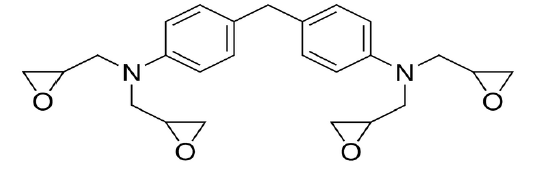
- Highly Rigid Aromatic Backbone (Diamino diphenyl methane): At the center of the molecule lies a diphenyl methane structure formed by two phenyl rings connected through a methylene bridge. This aromatic backbone provides exceptional rigidity, mechanical strength, and thermal stability far beyond what conventional aliphatic resins can achieve.
- Four Highly Reactive Crosslinking Sites (Tetraglycidyl): Attached to both ends of the rigid backbone are nitrogen atoms derived from amine groups. Each nitrogen atom is further connected to two glycidyl groups (epoxy functional groups). As a result, every TGDDM molecule possesses four highly reactive functional sites capable of reacting with curing agents.
In practical formulations, the Epoxy Equivalent Weight (EEW) of this type of resin typically ranges from 115 to 134 g/eq. Its low EEW combined with tetrafunctionality enables an extremely high concentration of reactive sites within the formulation at the same weight. Once fully cured with hardeners, these reactive points form an exceptionally dense three-dimensional polymer network. This extraordinarily high crosslink density is the fundamental reason behind TGDDM’s outstanding performance.
2. Breaking Physical Limits: Core Performance Characteristics
Built upon its ultra-dense crosslinked molecular structure, TGDDM exhibits a series of properties specifically designed for extreme environments.
- Excellent Thermal and Chemical Resistance: TGDDM demonstrates outstanding thermal resistance and excellent chemical resistance. Even under harsh environments and elevated temperatures, the material maintains excellent rigidity and dimensional stability while resisting chemical degradation, deformation, and performance loss.
- Excellent High-Temperature Mechanical Performance Retention: Even at elevated operating temperatures, the resin maintains strong mechanical integrity and structural stability with minimal degradation. This characteristic is particularly critical for equipment exposed to repeated thermal cycling and severe temperature fluctuations.
- Good Processability with Stable Processing Characteristics: Despite its high reactivity, TGDDM still provides a practical processing window under manufacturing conditions. It does not cure excessively fast during processing, allowing sufficient working time for coating, dispensing, impregnation, or encapsulation operations.
3. Processing Challenges, Flowability Control, and Safety Considerations
As with many high-performance materials, exceptional physical properties often come with processing trade-offs. Several important processing characteristics must therefore be considered when using TGDDM specialty resins.
Due to its tetrafunctional structure and rigid aromatic rings, TGDDM typically appears as an extremely viscous or semi-solid clear brown liquid at room temperature (25°C). Consequently, viscosity testing and manufacturing operations are commonly performed under heated conditions around 50°C. At 50°C, the standard viscosity generally falls between 8,000 and 18,000 cps.
To satisfy different production requirements, manufacturers have also developed multiple derivative grades based on the same chemical backbone. Low-viscosity versions designed for improved penetration and flowability can reach approximately 3,000–6,000 cps at 50°C, while high-viscosity versions tailored for prepreg or thick-film applications may reach 11,000–15,000 cps. This flexibility allows TGDDM systems to adapt to a wide range of dispensing, encapsulation, and composite manufacturing equipment.
4. Applications That Challenge the Impossible
Because of its excellent mechanical strength, extreme heat resistance, and chemical durability, TGDDM resin is widely used in some of today's most demanding industrial applications.
- Aerospace and Advanced Composites: This remains TGDDM's most important application field. The resin is extensively used in high-performance aerospace structural components for both military and commercial aircraft. Combined with laminated composite technologies, it enables the production of lightweight structures with extremely high strength and thermal stability.
- Advanced Semiconductor Packaging and Electronic Adhesives: In modern 5G communication systems and high-performance computing devices, semiconductor chips generate substantial heat during operation. TGDDM-based systems are widely used in advanced electronic adhesives, particularly underfill materials and structural adhesives. Its dense polymer network effectively withstands severe thermal shock while protecting delicate microelectronic components from thermal stress, moisture ingress, and chemical contamination.
- Protective Coatings and High-Performance Resin Modifers: In addition to serving as a primary resin, TGDDM is also widely used as a high-performance resin modifier. Even small additions can significantly enhance the adhesion strength, corrosion resistance, and overall durability of industrial coatings and structural adhesives.
Tetrafunctional specialty epoxy resins such as TGDDM are not designed for ordinary applications. They are engineered specifically to withstand high temperatures, high stress, and harsh operating environments.
From the molecular level—with its highly reactive multifunctional structure and rigid aromatic backbone—to its outstanding real-world thermal and mechanical performance, TGDDM offers clear advantages in mission-critical applications. By properly managing processing conditions and manufacturing parameters, its full performance potential can be realized.
For developers working on advanced electronic packaging, aerospace composites, or other high-end engineering applications, TGDDM is not merely a material upgrade—it is a key enabler for achieving higher reliability, improved thermal endurance, and superior overall product performance.
#TGDDM #EpoxyResin #HighTemperatureMaterials #ElectronicPackaging #SemiconductorMaterials #AdvancedPackaging #Underfill #StructuralAdhesives #HighPerformanceMaterials #MaterialsEngineering
CONTACT US
Kelly Chemical Corporation
Electronics
TEL:(02)2762-1985 ext 11200
Online Message
Leave your contact information,
and we will get in touch with you soon.
Email Consultation
After receiving your email,
we will process it as soon as possible.send Email


