TGMXDA Epoxy: High Performance, Easy Processing
Material Challenges in Advanced Packaging: Balancing High Heat Resistance, Low Viscosity, and Reliability
As advanced packaging technologies such as CoWoS and FOPLP continue to evolve alongside high-end automotive and aerospace electronics, packaging materials are facing increasingly demanding requirements. They must withstand extreme temperatures while maintaining excellent dimensional stability, minimizing warpage and deformation throughout the manufacturing process.
Traditionally, however, manufacturers have encountered a persistent dilemma: the higher the heat resistance of an epoxy resin, the higher its viscosity at room temperature—often becoming semi-solid or paste-like. Inorder to achieve acceptable coating and dispensing performance, production lines typically require the resin to be preheated, increasing energy consumption, extending process time, and reducing manufacturing flexibility.
To overcome this long-standing trade-off between thermal performance and processability, a new-generation epoxy resin based on Tetraglycidyl m-Xylylenediamine (TGMXDA) has been developed. Its greatest advantage lies in delivering excellent flowability at room temperature without any preheating while still providing outstanding thermal resistance and warpage control after curing. In other words, it simplifies manufacturing, reduces energy consumption, and enables more efficient high-precision packaging processes.
Core Innovation: Extreme Crosslink Density with an Intrinsically Low-Viscosity Backbone
The exceptional performance of TGMXDA originates from its carefully engineered molecular structure.
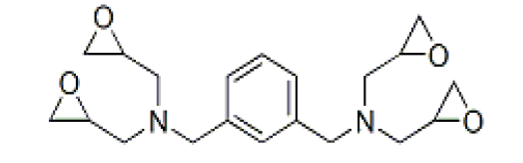
- High Density of Reactive Sites (Low Epoxy Equivalent Weight): Each TGMXDA molecule contains four highly reactive epoxy groups, resulting in an exceptionally low epoxy equivalent weight (EEW) of only 95–110 g/eq. This low EEW means a significantly higher concentration of reactive sites per unit mass, allowing the cured resin to rapidly form a highly crosslinked three-dimensional network. The resulting polymer network delivers outstanding thermal and mechanical performance, including a glass transition temperature (Tg) exceeding 200–240°C, high rigidity, and excellent chemical resistance.
- Low Viscosity through the MXDA Molecular Backbone: Conventional aerospace-grade tetrafunctional epoxy resins, such as TGDDM (Tetraglycidyl Diaminodiphenylmethane), possess rigid aromatic backbones that result in extremely high room-temperature viscosity. In many cases, processing equipment must be heated above 50°C simply to reduce viscosity to approximately 3,000–18,000 cps. TGMXDA replaces the rigid diphenylmethane backbone with an m-xylylenediamine (MXDA) structure. The methylene linkage introduces greater rotational freedom and molecular flexibility while maintaining four epoxy functional groups. Consequently, its viscosity at 25°C is reduced to only 1,600–3,000 cps. This breakthrough enables excellent coating flow, wetting performance, and room-temperature processing without the need for equipment preheating.
Comparison of Material Properties and Processing Performance
| Property | TGMXDA-Based Specialty Resin | Conventional Aerospace-Grade TGDDM Resin | Manufacturing Benefit |
|---|---|---|---|
| Chemical Structure | Tetraglycidyl m-Xylylenediamine | Tetraglycidyl Diaminodiphenylmethane | Greater molecular flexibility |
| Epoxy Equivalent Weight (EEW) | 95–110 g/eq | 115–130 g/eq | Higher crosslink density, improved rigidity and chemical resistance |
| Viscosity at 25°C | 1,600–3,000 cps | Semi-solid / Paste (>50,000 cps) | Room-temperature processing without preheating |
| Processing Requirement | Direct room-temperature coating and dispensing | Preheating to 50–80°C required | Lower energy consumption and more stable viscosity control |
| Thermal Stress & Warpage Resistance | Excellent (low shrinkage, low CTE) | Moderate (higher internal stress due to rigid structure) | Significant advantage for large-package and FOPLP applications |
Application Example: Balance Films for Panel-Level Packaging
The unique combination of low viscosity and high thermal performance makes TGMXDA particularly valuable in semiconductor advanced packaging. A representative application is the Balance Film, which is widely used in panel-level packaging to suppress warpage caused by thermal stress mismatch during redistribution layer (RDL) fabrication. Industry specifications often require panel warpage to be controlled within 0.3 mm.
The low viscosity of TGMXDA enables the resin to spread uniformly into an ultra-thin coating layer during application, while its densely crosslinked tetrafunctional network provides excellent mechanical strength and stress resistance after curing. These characteristics make it highly suitable for advanced protective materials such as Balance Films and Back Grinding (BG) Tape.
Understanding the Chemistry of Glycidyl Amine Epoxy Resins
Although TGMXDA exhibits outstanding thermal and mechanical performance, formulators should carefully consider its chemical characteristics when designing curing systems.
- Potential Interaction with Cationic UV-Curing Systems
TGMXDA belongs to the glycidyl amine family of epoxy resins. Its molecular structure contains tertiary amine nitrogen atoms possessing lone-pair electrons. When used in cationic UV-curing systems, where photoacid generators (PAGs) produce strong acids to initiate epoxy ring-opening polymerization, these basic nitrogen atoms may partially neutralize the generated acid. This phenomenon, commonly referred to as catalyst poisoning, can reduce curing efficiency or even lead to incomplete curing. Therefore, additional formulation optimization and compatibility evaluation are generally required before incorporating TGMXDA into cationic UV systems.
- The Ideal Platform: Latent Thermal Curing Systems
TGMXDA demonstrates its greatest advantages in latent heat-curing formulations.
- Excellent Compatibility: Thermally activated curing mechanisms are generally unaffected by the basic amine structure, allowing complete crosslinking reactions to proceed efficiently.
- Long Pot Life: The resin remains relatively unreactive at room temperature and moderate temperatures. After mixing, formulation viscosity remains stable for extended periods, providing manufacturers with ample processing and coating time.
- Fast Snap Cure Potential: When heated to 120–180°C, the four highly reactive epoxy groups rapidly participate in crosslinking, enabling fast curing and the formation of a dense polymer network. This makes TGMXDA particularly suitable for high-throughput semiconductor packaging production.
Conclusion
TGMXDA successfully combines two characteristics that have traditionally been difficult to achieve simultaneously: excellent room-temperature processability through low viscosity and exceptional thermal performance through an ultra-high crosslink density.
For manufacturers developing advanced semiconductor anti-warpage materials, aerospace composite matrices, or high-performance automotive electronic encapsulants, TGMXDA offers an effective solution to long-standing processing challenges. By understanding the basic nature of glycidyl amine chemistry and pairing the resin with an appropriate thermal curing system, manufacturers can eliminate issues associated with highly viscous conventional high-temperature resins, including non-uniform coating and repeated equipment preheating.
#TGMXDA #LowEEW #HighCrosslinkDensity #AdvancedPackaging #AntiWarpage #Underfill #SemiconductorMaterials
CONTACT US
Kelly Chemical Corporation
Electronics
TEL:(02)2762-1985 ext 11200
Online Message
Leave your contact information,
and we will get in touch with you soon.
Email Consultation
After receiving your email,
we will process it as soon as possible.send Email


