Towards High Frequency and High Speed: Low Dk Material Formulation Design Guide
Towards High Frequency and High Speed: Low Dk Material Formulation Design Guide
Nowadays, with the rapid advancement of 5G/6G communications, AI servers, and advanced packaging technologies such as CoWoS and FOPLP, Low Dk (low dielectric constant) and Low Df (low dielectric loss) have become two of the most critical performance requirements in high-frequency electronic materials.
With such a wide variety of resin materials and monomers available on the market, how can formulation engineers select the most suitable molecular structures to develop resin systems that meet the stringent requirements of high-frequency signal transmission? Likewise, how should synthetic chemists design new molecular architectures or introduce appropriate functional groups to create novel monomers and specialty resins with the electrical properties required for next-generation electronic applications? These challenges have become the focal point of current materials research, driving continuous efforts to identify the key molecular designs that can deliver breakthroughs in electrical performance.
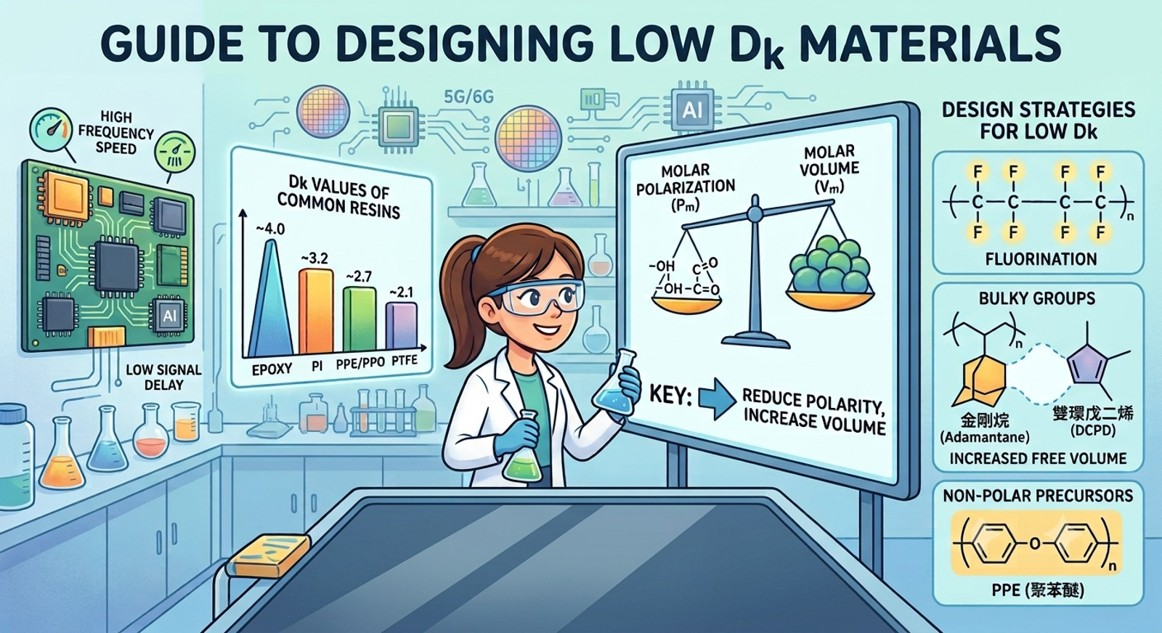
I. Why Do Semiconductor and High-Frequency Applications Require Low Dk Materials?
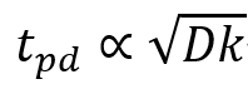
In high-frequency electronic circuits, signal transmission speed is directly related to the dielectric constant (Dk) of the insulating material. According to electromagnetic wave propagation theory, the propagation delay of a signal traveling through a dielectric medium is proportional to the square root of its dielectric constant:
- Reduced signal delay: A lower Dk enables faster signal propagation, resulting in lower transmission latency.
- Lower parasitic capacitance: Low-Dk materials reduce parasitic capacitance between adjacent conductors, minimizing crosstalk and improving signal integrity.
- Reduced transmission loss: Although dielectric loss is primarily determined by the dielectric dissipation factor (Df), a lower Dk also contributes to reducing overall electrical losses at high frequencies.
For this reason, Low-Dk material design is essential for developing advanced packaging materials with ultra-low latency and high signal fidelity, including underfills, molding compounds, and printed circuit board (PCB) substrates.
II. Typical Dk Values of Common Resin Materials
In practical formulation design, thermosetting and thermoplastic resins are commonly used as the base materials. Due to differences in their molecular backbones, these resins exhibit significantly different dielectric constants (Dk).
| Resin Type | Abbreviation | Typical Dk (10 GHz) |
Characteristics and Applications |
|---|---|---|---|
| Epoxy Resin | Epoxy | 3.5–4.5 | Excellent processability and strong adhesion. However, the presence of polar hydroxyl (-OH) groups results in a relatively high dielectric constant. |
| Polyimide | PI | 3.0–3.5 | Outstanding thermal stability, widely used in flexible printed circuits (FPCs) and high-temperature processing applications. Polar imide groups and relatively high moisture absorption tend to increase the measured Dk. |
| Bismaleimide Resin | BMI | 2.8–3.3 | High glass transition temperature (Tg) and low coefficient of thermal expansion (CTE). Contains polar imide structures and is often blended with other low-Dk resins to optimize overall performance. |
| Polyphenylene Ether Resin | PPE / PPO | 2.6–2.8 | Highly symmetrical molecular structure with excellent electrical properties, making it one of the mainstream matrix resins for high-frequency, high-speed copper-clad laminates (CCLs). |
| Polytetrafluoroethylene | PTFE | 2.0–2.1 | Offers exceptional dielectric performance but suffers from poor processability and adhesion, making material modification challenging. |
III. How Does Molecular Structure Affect the Dielectric Constant?
The design of Low-Dk materials begins with the fundamentals of physical chemistry. The dielectric constant represents a material's ability to become polarized in an electric field. In general, the greater the degree of polarization, the higher the dielectric constant. According to the Clausius–Mossotti equation:
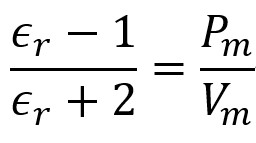
Where:
- Pm = Molar Polarization
- Vm = Molar Volume
This relationship indicates that the fundamental strategies for reducing the dielectric constant are to decrease molecular polarizability (Pm) or increase molecular volume (Vm).
- Effect of polar functional groups (Pm): Molecules containing highly polar functional groups, such as hydroxyl (-OH), carbonyl (C=O), cyano (-CN), and ether linkages (-O-), undergo strong orientation polarization under an alternating electric field, resulting in a significant increase in the dielectric constant. Conversely, incorporating a larger proportion of low-polarity hydrocarbon structures can effectively reduce Dk.
- Effect of molecular symmetry: Highly symmetrical molecular structures tend to exhibit lower net dipole moments because individual dipoles cancel one another. Typical examples include the symmetrical C–F bonds in PTFE and symmetric aromatic ring structures, both of which contribute to reduced molecular polarizability.
- Effect of free volume (Vm): Introducing bulky, rigid, or three-dimensional cyclic structures hinders tight molecular chain packing, thereby increasing the material's free volume. Since air has a dielectric constant close to 1.0, increasing free volume effectively introduces low-Dk regions within the material, leading to a lower overall dielectric constant.
IV. Conclusion: Synthesis and Formulation Strategies for Low-Dk Materials
When developing next-generation Low-Dk materials, four key molecular design strategies are commonly adopted:
- Depolarization Modification: For conventional epoxy systems, hydroxyl-free curing chemistries—such as active ester curing agents—can be employed to minimize the formation of hydroxyl (-OH) groups during curing. Alternatively, the residual hydroxyl groups generated after curing can be end-capped through esterification, thereby reducing the number of exposed polar functional groups.
- Fluorination: The C–F bond exhibits extremely low polarizability, while fluorine's high electronegativity strongly localizes electrons, making fluorination one of the most effective approaches for reducing both the dielectric constant (Dk) and dielectric loss (Df). However, fluorinated materials often present challenges such as reduced compatibility with other resins and poorer adhesion, which must be carefully addressed during formulation.
- Incorporating Bulky, Non-Coplanar Structures: Introducing large, rigid, and nonpolar molecular frameworks—such as dicyclopentadiene (DCPD), biphenyl, adamantane, and naphthalene—can increase molecular free volume (Vm), thereby lowering the dielectric constant. These structures also enhance thermal properties, including glass transition temperature (Tg), thermal decomposition temperature (Td), and coefficient of thermal expansion (CTE).
- Enhancing Molecular Symmetry: Designing curing agents or prepolymers with highly symmetrical molecular structures helps reduce the overall dipole moment of the crosslinked network, thereby suppressing dielectric polarization and further lowering the dielectric constant.
The design of Low-Dk materials inevitably involves trade-offs between thermal performance (such as high Tg and low CTE) and mechanical properties (including adhesion and toughness). Achieving the optimal balance between low polarity and mechanical robustness through precise molecular design remains one of the greatest challenges in resin formulation.
#LowDk #CoWoS #FOPLP #DCPD #Biphenyl #Adamantane #Naphthalene #5G #6G #HighFrequency #DielectricLoss
CONTACT US
Kelly Chemical Corporation
Electronics
TEL:(02)2762-1985 ext 11200
Online Message
Leave your contact information,
and we will get in touch with you soon.
Email Consultation
After receiving your email,
we will process it as soon as possible.send Email


